The decision: assigning an existing student harness consistently without inventing a fitting standard
Consider a school that reassigns existing student harnesses to new students at the start of each course. Doing this consistently benefits from a record of what was checked, which manual applies to that specific harness, and what remains unresolved when the harness moves on. This article proposes a workflow for keeping that record. It is not a fitting protocol, a sizing method or a compatibility guarantee — it is an administrative habit for documenting an existing check, not a claim about how schools generally operate today.
Evidence boundaries: BHPA responsibilities, exact-model manuals and professional inspection services
Three kinds of source matter here, and they answer different questions. BHPA's Technical Manual sets out who is responsible for inspections in a training situation and recommends certain equipment for tuition — it does not supply a sizing chart or a harness allocation form. An exact-model owner's manual documents how that specific harness should be checked and adjusted — it does not generalise to other models. And a manufacturer's professional inspection service, such as the one ADVANCE describes, examines and documents a harness's condition to a defined scope — it is a separate record from anything a school keeps in-house. Keeping these three apart is the point of this article.
BHPA Amendment 24: Daily Inspection, Pre-Flight Check and Duty Instructor responsibility
BHPA's Technical Manual states that all equipment should be given a thoroughly detailed Daily Inspection at the start of the flying day, and distinguishes this from the Pre-Flight Check the student or pilot performs immediately before take-off. In a training situation, it places responsibility for ensuring that these inspections are carried out with the Duty Instructor (BHPA Technical Manual, Amendment 24). That's a distinction between two checks: the passage names the student or pilot as the one who carries out the Pre-Flight Check, while it doesn't specify who physically performs the Daily Inspection — only that the Duty Instructor is responsible for ensuring it happens. Neither check is, on its own, a harness-fitting protocol. The same page also carries a red-tag provision, but that sentence is written about unserviceable gliders specifically; nothing in it extends to a mandate for tagging harnesses, and this article doesn't treat it as one.
Suspended systems: BHPA's recommendation and a model-specific manufacturer manual example
BHPA recommends suspended harness systems for paragliding tuition (BHPA Technical Manual, Amendment 24). That's a recommendation about equipment type for teaching, not a sizing method or a universal fitting sequence. Separately, one manufacturer's owner's manual for a specific harness model documents adjusting that harness using a hanger or simulator, testing all adjustments, and becoming familiar with the harness and its parts, including the position of the reserve handle (SKY Gii 5 ALPHA owner's manual). That passage is cited only as a source example of what a model-specific manual covers — it is not a procedure to apply to any other harness a school owns, and the model itself is not a product Altura reviews, sells or recommends.
What ADVANCE's professional harness inspection service examines and records
ADVANCE describes a periodic inspection that visually examines safety-related components — straps, buckles, carabiners, protectors — and results in a report documenting the harness's overall condition (ADVANCE harness inspection). That report belongs to a professional inspection service with its own defined scope. A school's allocation record is not a substitute for it; where the applicable manufacturer's own maintenance documentation calls for a professional inspection, the allocation record simply notes whether one exists and references it — it doesn't replace it.
EDITORIAL WORKFLOW: fit-check, assign and record without claiming approval or compatibility
With those boundaries in place, a school can still make its own process more consistent. The workflow below is Altura's editorial proposal, not a BHPA form, a certified protocol, or proof that a harness fits, is serviceable, or is compatible with a given wing or reserve. It's a way to write down, each time a harness is assigned, what is known and what isn't.
Compact student harness allocation record template and the purpose of each field
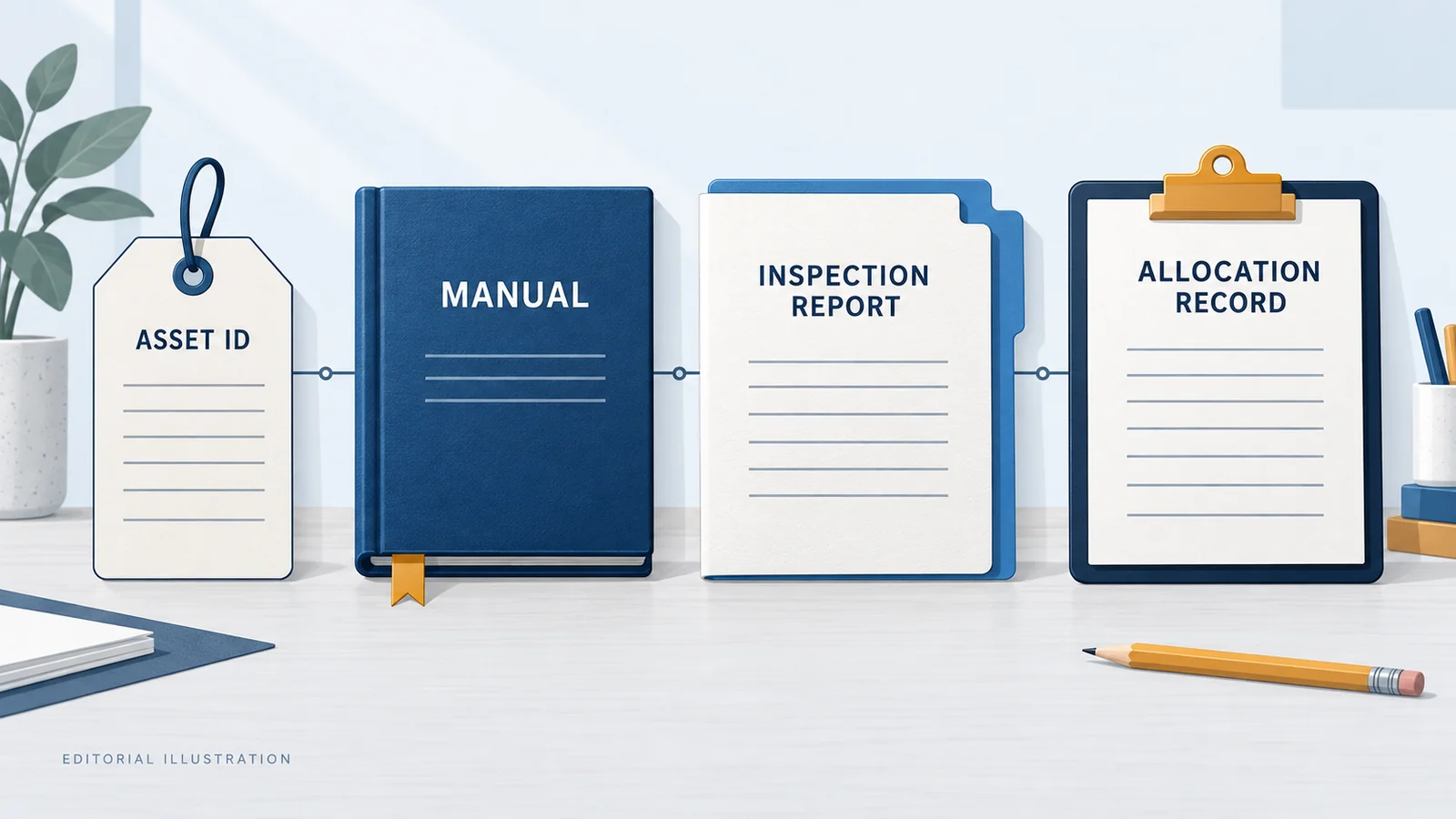
- Asset identity — which physical harness (serial or tag number), so the record follows the item, not just the student.
- Exact-model manual and version — a record of which manufacturer manual is identified as applicable to this harness, so the check can be traced back to the right documentation.
- Configuration reference — a note of the harness's current setup, without stating adjustment numbers, so later checks know what was in place.
- Inspection-report reference — a pointer to a professional inspection report if one exists, and its date, not a re-statement of its findings.
- Supervised check outcome — a plain note of what a qualified instructor observed during a supervised individual check, in their own words, not a pass/fail claim.
- Assignee, date, responsible instructor — who received the harness, when, and who supervised the check.
- Unresolved issue or action — anything not settled, flagged for follow-up rather than left implicit.
A blank field in any of these means unknown — not checked, not passed, not approved. That distinction matters more than any single field's content.
Hypothetical record-handling example: blanks, unknowns and unresolved actions
Imagine a school reassigning a harness at the start of a new course. The asset identity and manual reference are filled in. The configuration reference notes that the current setup hasn't been re-verified since the last course. The inspection-report field is blank, because no professional inspection has been logged for that harness this cycle. The supervised check outcome records only that an instructor observed the student under supervision and noted a strap adjustment that needs a second look. The unresolved-action field carries that forward. Nothing here says the harness is approved, fits, or is ready — it says what's known, what isn't, and what still needs attention.
Escalation and limits: exact-model instructions, qualified supervision, compatibility and reserve procedures
The allocation record described here is an administrative note, not a substitute for the applicable exact-model manual, a qualified instructor's judgement, or a professional inspection report. Questions about adjustment, body-fit, compatibility with other equipment, or reserve handling belong with that harness's own manufacturer instructions and with qualified supervision, not with this record. Where the record leaves a field unresolved, that gap simply marks what still needs checking against the applicable manual or raising with a qualified instructor — it is not evidence that the harness is unfit. Schools reviewing their existing harness stock alongside these records can also browse Altura's shop for equipment options.